
-
Memories and reflections: Lessons Learned From My Ten-Year-Old Self
Posted by Joanna Muise, Chair of the Editorial Board on 2024-07-18

Dear Readers,
The volunteer leadership that makes the IJFAE work continues to grow and diversify. In this commentary, we are introduced to our new Editorial Board Chairperson, Joanna Muise. She encourages us to reflect on when we started learning about first aid and inspires us to help our learners to recognize the strengths and talents they bring.
Editor-in-Chief, Jeffrey Pellegrino
IJFAE community members – close your eyes with me for a few moments and think about the first time you remember learning about first aid. As you replay the scene, consider how old you were. Where did your learning take place – what did the environment smell or sound like? What did you learn about, and who were you learning with? And most importantly, how did the learning make you feel? Oddly, I can answer each of these prompts because of a treasured learning artifact my ten-year-old self curated for me thirty years ago.
Growing up in Canada, I first started exploring the idea of safety (of myself and others) as a small child—maybe as young as three or four years old. It was layered into how I played and interacted with others. As I grew older, exploring the concept of safety became more formalized—considering how to be safe in my family's home, my neighbourhood, at school, and in recreation environments (like when I was learning how to swim).
I am sure I had dedicated safety responsibilities throughout elementary school. Still, the first time I remember learning 'first aid' and expecting to provide emergency care for others was when I decided to become a babysitter at the age of ten.
Let me briefly set the stage for you – the year is 1995. I wanted everything I owned to be neon coloured, and the song Macarena (by Los del Río) was going viral. I had a parent-selected hairstyle that my brother and I have affectionately come to call the 'mushroom cut' (reference photos will not be provided, but you can imagine – it was as awkward as it sounds). Most of all, I was obsessed with Ann M. Martin's young adult novels, called The Babysitters Club.
The series followed a group of adolescents living in a fictional town who ran a local babysitting business. The main characters were successful entrepreneurs at the top of the babysitting game with the most fabulous activity kits. Naturally, I wanted to be just like them. I begged my parents to enroll me in a babysitter training program when I turned ten. This program would be the first of many times I would learn 'first aid' throughout my adolescence.
The real story picks up when my mother discovers the greatest learning artifact my ten-year-old self could have ever provided me with as a first aid instructor, program designer, and researcher. Tucked away in the back of a basement closet, covered in dust, she discovered my old babysitting kit—including the notes I took when we were first taught 'Ressue Breathing'.
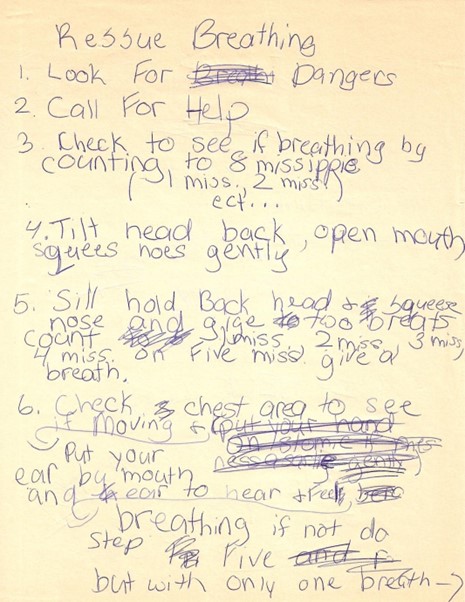
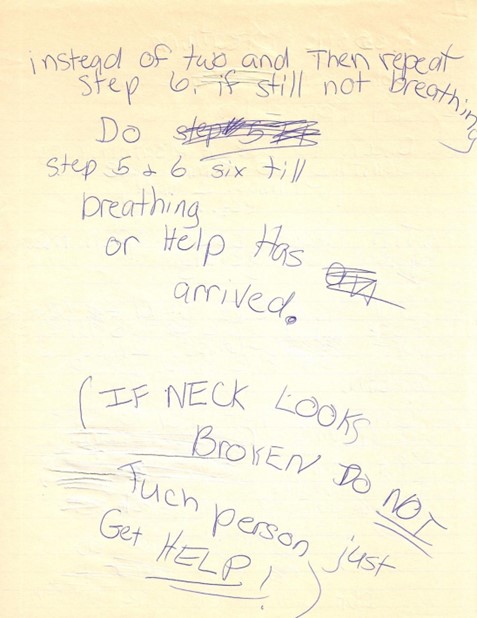
Let's address the obvious – despite being a determined and curious young person, spelling was not my greatest talent (and if I am being honest, it still isn't). In some ways, this lightly lined sheet of discoloured notebook paper is amusing, and I would be lying if I told you that my teammates and I didn't find laughter in recollecting what I once wrote. My overuse of capital letters was almost offensive, and as a Canadian child, why was I trying to use an American geographic reference to pace myself (for reference, I was trying to spell Mississippi – as in the Mississippi River). In the babysitting kit, there was also a copy of my twenty-five-question 'final examination,' graded in red ink, time-stamped with partial percentage points in the final score (in my educator and adult opinion, a ridiculous evaluation tool and process, particularly for ten-year-old’s, but that is a conversation for another day).
Humour aside, I want you to pause and look past the yellowing paper and poor spelling to really digest what is found on the pages. Look deeply. What can you identify among the twisted lines and scratched-out text? What is the persona of the learner who created these words and ideas? What were they thinking and feeling during the learning experience? What did they carry forward from this learning experience, and how did that leave them feeling the first (or twentieth) time they babysat?
When I look at these notes now, I see a panicked learner attempting to organize (unnecessarily) complicated care steps into a reliable and sensible sequence. I see a learner who is afraid to act – doubting their ability to help in an emergency and worried that they will cause further harm. I see a learner filled with anxiety rather than confidence. Despite continuing to explore various helping roles throughout my adolescence and adulthood, as a first aid educator, my heart hurts for the ten-year-old who took these chaotic notes thirty years ago.
Sadly, I can't go back in time and fix this learner's experience (nor their horrible haircut; thanks again for that one, Mum and Dad). But what I can do, when I show up as an educator, program designer, and researcher is to honour that young person by ensuring that other learners (at any stage of their first aid learning journey and across their lifespan) don't relive the same experience.
When I engage learners, I focus my energy on building them up - giving them the knowledge, skills, and confidence to help in an emergency. Do I care if they give 33 chest compressions instead of 30 when practicing (or performing) CPR? No, I don't. Do I care if they built the world's most beautiful splint and sling? Not a chance—as long as what they created does the job, I tell them well done.
This unexpected learning artifact reminds me that my primary role is to inspire learners to demonstrate kindness and compassion – for those they help and for themselves. Do I need to ensure that someone can demonstrate the competence required to be certified in first aid? Yes, but how I lead them along that journey and help them recognize the strengths and talents they bring as helpers is far more valuable to me and meaningful to them.
As a side note – most Canadian first aid and resuscitation training programs for the lay public sought to simplify their content not too many years after I completed my babysitter training program, focusing on CPR and eliminating rescue breathing as a separate skill to streamline the decision-making process (in the primary assessment) and encourage confident action by first aiders. They reduced the confusion associated with punitive learning methods (be sure not to…make sure you don't…whatever you do, don't…) and focused on clear, simple actions that more learners could confidently understand and apply.
My ten-year-old self would never have predicted that one day, I would anchor years of my professional practice in first aid education (mostly because Free Willy, the movie, was popular in 1995, and I was convinced I would become a marine biologist and work at SeaWorld). The opportunity to reflect on my own experiences as an adult through the lens of a personal learning artifact has been an unbelievable gift that I am very appreciative for.
I would love to hear from our community:
- What do you think of when you read the ‘ressue breathing’ notes?
- How does this experience compare to the first time you learned first aid?
- How do you approach building confidence in your learning environments? Does this look different if the learners are adults or young people?
- If you could travel back in time, what would you tell that ten year old?
- What reflections can you take forward in your current day instructional practice?
It is a privilege to contribute to the knowledge and practices of those involved in first aid and first aid education so that together, we can continue building the resilience of individuals and communities worldwide. I hope that sharing this story helps you better understand my values and motivations as a member of this community and inspires you to consider the incredible influence and opportunity you have every time you teach first aid or develop learning programs.
Every one of you reading this is dedicated to improving the learning experiences of others and is helping to make our shared communities stronger and more compassionate; thank you for sharing your time and talents with others. I look forward to our continued collaboration within this incredible community.
Be well,
Joanna
Back to News List